Research Areas

From AI context to
user-side consequence

The current programme begins with AI context as the umbrella problem, then follows that question into user-side phenomena, post-interaction assessment, and bounded engineering translation.

Four public areas of work

These areas are linked but analytically distinct, and together they define the current public programme.

Area 01

AI context and conversational conditions

The structural conditions that shape interpretation: role, framing, continuity, repetition, memory cues, emotional expectation, and interaction setting.

Area 02

User-side change and prolonged interaction

How trust, dependence, self-checking, and decision habits can change when AI becomes a repeated relational presence.

Area 03

Assessment and case reading

Methods for reading an interaction after it has accumulated, rather than treating each answer as a self-sufficient event.

Area 04

Public methods and governance relevance

How research becomes a usable public language for evidence, auditing, case analysis, and governance discussion.

Current line of work

The current line of work is cumulative. CXC-7 establishes conversational context as structure. CXOD-7 examines contextual operation and pressure. USCH defines one user-side phenomenon within that wider field. USCI specifies post-interaction assessment. A-CSM translates one branch into a bounded technical layer.

That sequence matters because each layer depends on the one below it: the programme moves from conceptual field, to system-layer coherence, to user-side phenomenon, to assessment, and finally to implementation logic.
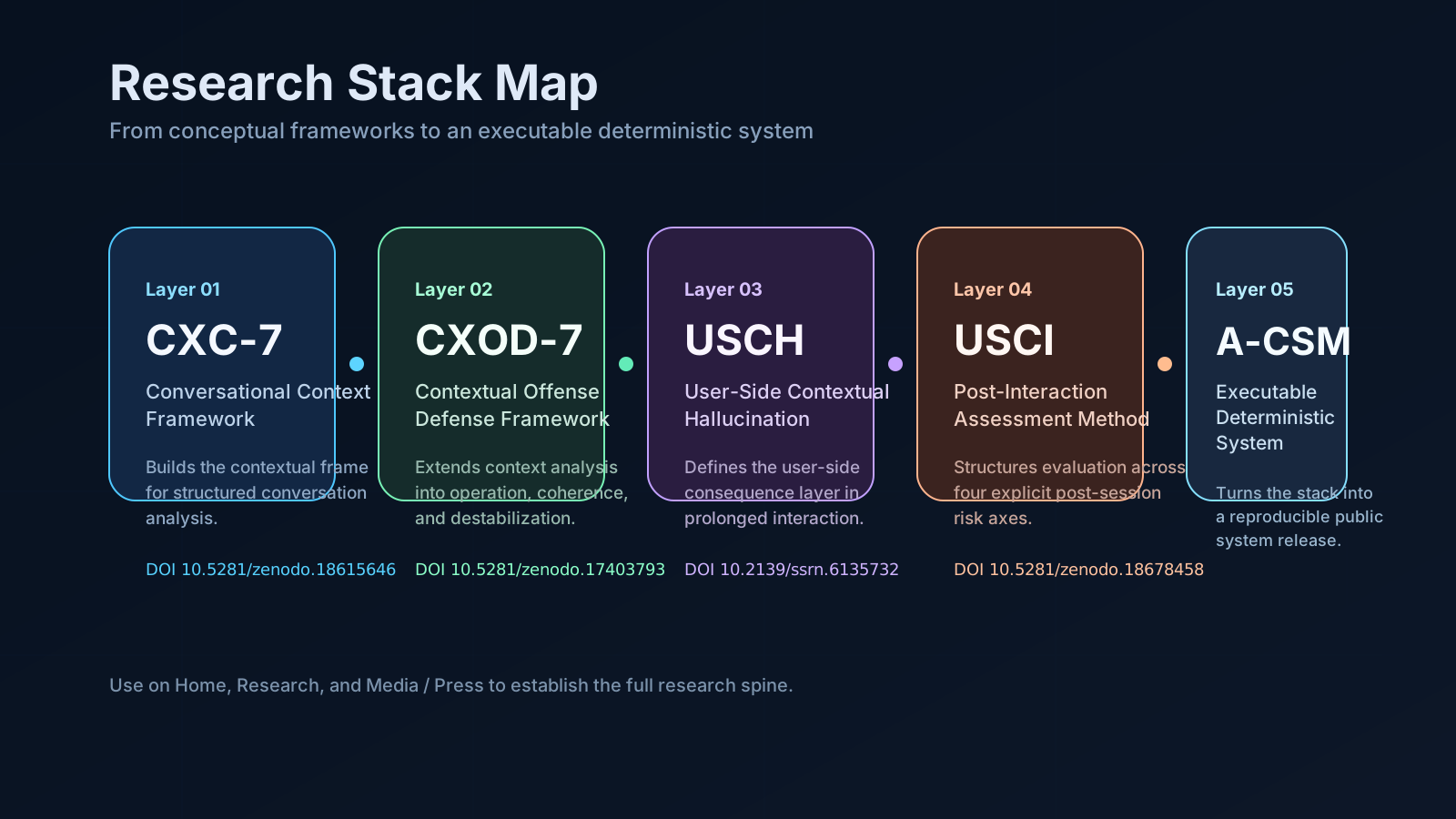
Program map

The map helps readers see how the current public work holds together.

Research stack map

What each part of the work actually does

The summaries below state the function of each layer in the current research programme.

CXC-7

Context as structure

A way to describe what makes a conversation meaningful before asking whether a reply is safe or unsafe.

CXOD-7

Context under pressure

A way to study how mode, role, and context can shift under pressure even when safety language remains nominally present.

USCH

A user-side phenomenon

A framework for describing observable user-side distortions and dependencies in prolonged interaction.

USCI

Post-interaction assessment

A structured way to talk about what an interaction has become after multiple turns, not just what happened in one answer.

A-CSM

Bounded implementation

Public technical work that translates one branch of the programme into a bounded engineering baseline.

Entry Points

Suggested starting pages

  • AI Context for the conceptual starting layer.
  • USCH 14 for the full list of observable phenomena.
  • Papers & Notes for the formal record and supplementary notes.
  • Media / Press for citable sources and contact.

Methods and Supporting Pages

Methodological and supporting pages

Methods, validation materials, and notes remain available for readers who need applied detail after the main research sequence has been established.